Check wedding venue accessibility by following the complete route your guest will use, from the drop-off point to their table, toilet, ceremony area and exit. A ramp at the entrance tells you very little about the rest of the visit.
Before booking, arrange a viewing of the exact room and ask to see the proposed wedding layout. Take measurements and photographs, then confirm that the arrangements suit your guest’s wheelchair and preferences.
Ask Your Guest What They Need
Speak privately with your guest before sending accessibility questions to the venue. Wheelchairs differ in size, and people have different requirements for turning, transferring and personal assistance.
Ask what would make attending comfortable. Useful details might include their wheelchair’s overall width and length, whether they need space beside a companion, and any particular toilet arrangements.
Offer to share photographs or a short video of the route. Invite them to the viewing if they would find it useful, without making attendance their responsibility.
Ask before providing assistance or touching their wheelchair. Share access requirements with staff only with the guest’s agreement; there is no need to circulate medical information.
Follow the Route From Arrival to Reception
Start outside the building. If your guest will arrive in a vehicle with a wheelchair ramp or lift, check that the drop-off area has enough space for it to operate safely.
Inspect the route from accessible parking as well. A nearby parking space is useful only if the path to the entrance is usable.
Look for:
- Kerbs or single steps without an alternative route.
- Uneven paving, loose gravel or gaps that could catch wheels.
- Steep slopes and ramps with obstructed landings.
- Doors or gates that may be locked during the reception.
For a Singapore wedding, ask how guests will reach the entrance during rain. Check shelter and drainage, and confirm that any alternative route remains accessible.
If guests are arriving by MRT, provide the relevant lift exit and onward route after checking them.
Measure Doorways and Check the Lifts
Ask staff to demonstrate the entire route to your booked room. Measure the usable opening of narrow doors, rather than the door frame alone. Check the space needed to approach, open and pass through each doorway.
A corridor may look wide until a tight corner, heavy door or raised threshold interrupts it.
Where a lift is needed, request its door opening, internal width and depth, and rated capacity. Compare these with the wheelchair and any accompanying person or equipment. Check that the guest can enter, use the controls and leave comfortably.
Ask whether the lift serves every relevant floor and remains available throughout your booking. What happens if it breaks down?
For ramps, request the gradient and dimensions. If suitability is uncertain, ask the venue to obtain qualified advice before you rely on the route.
Inspect the Accessible Toilet Yourself
Ask to see the actual accessible toilet. A symbol on the floor plan does not show whether its layout suits your guest.
Check the route from the reception room and whether using the toilet requires another lift journey. Inside, look at the doorway, turning space, grab bars, basin access and space beside the toilet for transferring.
Photographs can help your guest assess whether the transfer arrangement works for them. Keep these discussions private.
Confirm that bins, cleaning equipment and stored furniture will not occupy the clear space. Ask whether the emergency call system works and who responds.
If your guest needs a hoist, adult changing bench or room for assistance, verify these separately. An accessible toilet does not automatically include them. Confirm access throughout the event.
Review Seating With the Wedding Layout in Place
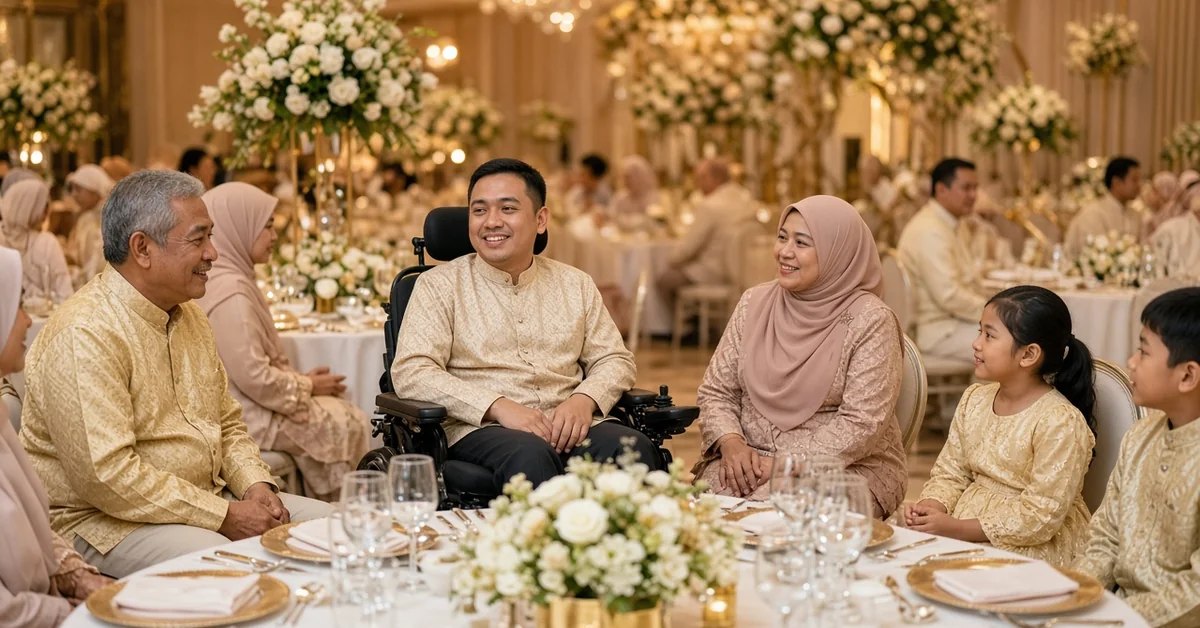
An empty ballroom can feel spacious while a fully seated reception becomes difficult to navigate. Request a floor plan showing tables, chairs, buffet queues, decorations, photography equipment and the pelamin.
Check aisle widths with chairs pulled out as they would be during dinner. There should be usable routes to the guest’s seat, toilets and exits without repeatedly asking others to move.
Offer seating choices alongside family or friends. Check the view of the ceremony and speeches from a seated position.
Inspect the dining table itself. The wheelchair needs enough knee and foot clearance, and table legs or a deep underside can prevent a comfortable approach.
When discussing Malay wedding packages, ask whether the proposed guest count allows the clear routes and table arrangement you need.
Include the Ceremony, Photographs and Meal Service
List every part of the celebration your guest may want to join. For a Malay wedding, that could include the solemnisation, family photographs, greeting the couple and accessing a prayer space.
Check whether the pelamin or photography platform has steps. If a guest will need access, arrange a suitable ramp or lift with the venue, or agree on an accessible photography setting with the couple and photographer.
For prayer facilities, check the approach, doorway and any washing arrangements your guest needs.
At the buffet, consider whether the guest can approach food displays, see the choices and reach utensils. Ask whether staff can bring their chosen food and drinks to the table if requested.
Keep the same menu choices available. Agree on assistance beforehand, so your guest can enjoy the meal without having to negotiate each course.
Ask About Emergency Evacuation
Ask the venue’s safety team how a guest who cannot use stairs would evacuate from your specific reception room.
Request a clear explanation of the designated route, any protected holding point, how assistance is called and which trained staff will respond. Check how those arrangements apply during your event hours.
Do not assume that the passenger lift used on arrival can be used during a fire. Any evacuation lift or specialist equipment must form part of the building’s emergency arrangements.
Discuss the plan with your guest. Carrying someone or their wheelchair should never be an improvised solution agreed between relatives on the day.
Get the Agreed Arrangements in Writing
Before confirming your wedding venue in Singapore, record what has been checked and what still needs resolving. Ask for a marked floor plan and written confirmation of:
- The entrance, drop-off point and lift route to use.
- Toilet location and availability.
- Seating, table clearance and routes through the room.
- Access to photographs, ceremony spaces and dining.
- Any equipment or layout changes, including costs.
- The staff contact responsible for access arrangements.
Send your guest concise arrival instructions and a contact number. Brief the venue team, ushers, decorators and photographer on the arrangements relevant to their work.
Recheck the route after the room is dressed, before guests arrive. A welcome sign, flower stand or spare chair can undo careful planning.
To arrange a viewing, contact Malay Wedding Venue with your preferred date and access questions. Ask the team to show how your guest will move through the exact spaces proposed for your celebration.
Frequently Asked Questions
Is an entrance ramp enough?
No. Check the complete route, including lifts, toilets, seating, dining areas and emergency arrangements.
When should I check venue accessibility?
Before booking, then again after the wedding layout and decorations are in place.
Where should guests who use wheelchairs sit?
Offer a choice alongside family or friends, with clear access, suitable table clearance and a good view.
Do accessible toilets include hoists?
Not necessarily. Confirm hoists, changing benches and assistance space separately if your guest needs them.